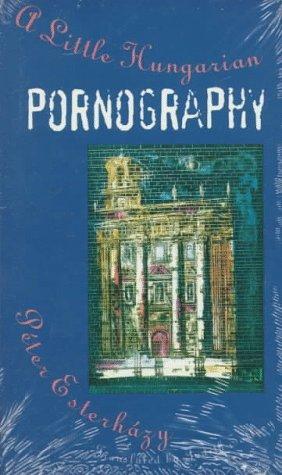
A Little Hungarian Pornography
Péter Esterházy · 1950–2016 · Hungary
Originally Kis magyar pornográfia (Hungarian)
Why it matters
Its title is a decoy: fragments of sex, family, and daily humiliation assemble into a satirical anatomy of the real obscenity on display under Kádár-era Communism. Esterházy's most overtly political early novel, disguised as something else entirely.
At a glance
Fragmented, aphoristic vignettes without a continuous plot ask for patience rather than a straightforward read.
Deep dive
Its title promises smut and delivers something closer to a family's private moments catalogued with the same clinical distance a secret police file would use, and Esterházy wants you to notice which one is actually obscene.
Written for readers who have finished the book. No plot recap, and nothing here is safe to read first.
Themes & symbolism
Esterházy structures the novel as a sequence of short, numbered, aphoristic fragments, family scenes, sexual encounters, domestic arguments, that borrow pornography's clinical, itemizing habit of attention without ever delivering pornography's actual content, a bait-and-switch that is the book's whole argument: the real violation on display isn't sexual, it's the state's total license to catalogue, monitor, and report on its citizens' private lives with exactly the same detached thoroughness. Fragments describing intimate family moments sit beside passages that mimic the flat, bureaucratic language of a surveillance report, and Esterházy lets the two registers blur until it becomes genuinely hard to tell, inside a single paragraph, whether a sentence is a memory or a file entry.
The novel's fragmentation is itself a form of self-protection as much as style, since its scattered structure and its title's pornographic decoy were calculated to slip past Kádár-era censors more interested in policing explicit political content than sorting through vignettes that read, on a hostile skim, like formally difficult smut rather than systemic critique. Esterházy, writing from inside Hungary's most storied aristocratic family, one stripped of its estates and status by the Communist state, brings a specific, inherited knowledge of what it feels like to have one's private life treated as a matter of public record to a book that keeps insisting the intimate and the surveilled were never actually separate categories under the regime it describes.
The Family the State Already Had a File On
The Esterházys had been one of Hungary's grandest aristocratic houses for centuries before the postwar Communist government nationalized their estates and reclassified their descendants as class enemies, a downgrading that put the family under exactly the kind of official scrutiny the novel's surveillance-report fragments imitate. Writing this book meant turning an inherited, lived experience of being a file subject into literary method, using the state's own bureaucratic voice as raw material rather than simply protesting it from outside.
A Title Built to Slip the Censor
Kis magyar pornográfia's title borrows the deadpan format of Hungarian textbook titles, A Little Hungarian Grammar being the most famous example, and stages its own joke before the first fragment even begins: censors scanning for political content were far more likely to flag an ordinary-looking grammar-adjacent title for a closer look on grounds of possible obscenity than for the systemic critique actually hiding inside it. The decoy worked well enough that the novel became one of Esterházy's most widely read early books at home.