
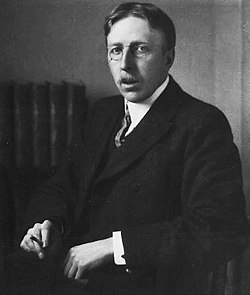
Ford Madox Ford
England
Deliberately scrambled chronology delivered by a narrator too self-deceived to see his own story straight: impressionism as a way of telling the truth slant.
Born Ford Hermann Hueffer, grandson of the painter Ford Madox Brown, he anglicized his name after the First World War amid anti-German feeling, having already spent years co-writing novels with his close friend Joseph Conrad and absorbing Conrad's belief that prose should render impressions, not just facts.
As an editor he had an outsized eye for talent, publishing early work by D. H. Lawrence, Ezra Pound, and Hemingway in the English Review and the Transatlantic Review. The Good Soldier (1915) put his own theories into practice: a devastating story of two marriages and a betrayal, told achronologically by a narrator who barely understands what he's confessing.
He served in the trenches in his forties, wrote it into the four-volume Parade's End, and spent his last years shuttling between Paris, Provence, and America, mentoring younger writers on both continents. He died in France in 1939.
Lines of influence
No descendants recorded, yet.
Their books in the atlas
- 1915
 The Good SoldierLvl 7psychological novel
Meanwhile, elsewhere
 1870–1953Ivan BuninRussiaRussia & Eastern Europe · Russia
 1873–1947Willa CatherUnited StatesNorth America · United States
 1871–1945Theodore DreiserUnited StatesNorth America · United States
 1873–1952Mariano AzuelaMexicoLatin America · Mexico
 1861–1941Rabindranath TagoreIndia (Bengal)South Asia · India (Bengal)
 1874–1946Gertrude SteinUnited StatesNorth America · United States
If you like Ford, try
 1857–1924Joseph ConradPoland / Englandshaped Ford · shared movement: High Modernism · both shaped by Flaubert
 1871–1922Marcel ProustFranceshared movement: High Modernism · both shaped by Flaubert · kindred genres: modernist, psychological novel
 1821–1880Gustave FlaubertFranceshaped Ford · kindred genres: psychological novel · neighboring movements
 1882–1941James JoyceIrelandshared movement: High Modernism · both shaped by Flaubert · kindred genres: modernist
 1861–1928Italo SvevoItalyshared movement: High Modernism · kindred genres: psychological novel, modernist · same region & era
 1848–1907Joris-Karl HuysmansFranceboth shaped by Flaubert · kindred genres: psychological novel · neighboring movements