
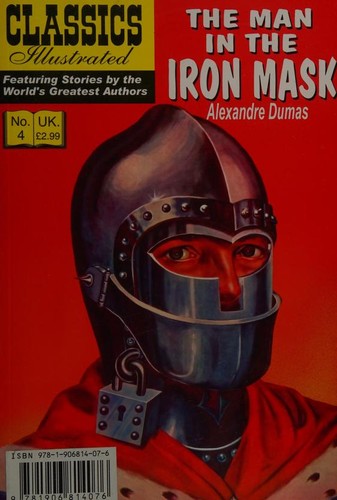
The Man in the Iron Mask
Alexandre Dumas · 1802–1870 · France
Originally The Man in the Iron Mask (French)
Why it matters
A mysterious prisoner's face is locked forever behind an iron mask while Aramis schemes to swap him for the king of France himself: the Musketeers' operatic last stand, and the source of one of fiction's most famous unsolved mysteries.
At a glance
Dense court intrigue sits inside otherwise fast, dialogue-driven serial prose.
Deep dive
The Musketeers' last adventure puts d'Artagnan on one side of a plot and Aramis and Porthos on the other, and Dumas finally lets the loyalty that survived a civil war in Twenty Years After break for good.
Written for readers who have finished the book. No plot recap, and nothing here is safe to read first.
Themes & symbolism
Aramis, having risen to genuine political power as a Jesuit general and bishop, discovers that Louis XIV has a secret identical twin, Philippe, imprisoned in obscurity since infancy, and plots to swap the two, installing a king he can personally control, the final escalation of a friendship that started as youthful mischief into outright treason against the crown all four men once served together. It's the clearest measure in the whole trilogy of how far ambition can carry someone who was once simply a duelist with good friends.
Dumas builds the mask itself from a genuine, unresolved historical mystery, a real masked prisoner held in French custody whose identity has never been definitively established even by historians, and pointedly declines to over-explain or moralize it within the fiction, letting the horror of an unseen, unnamed face do its own quiet work rather than tidying the legend into a neat solution.
Unlike the earlier two novels, where political division tests but ultimately doesn't break the friends' bond, this one lets it break outright: Porthos dies covering Aramis's escape once the twin-swap plot is discovered, d'Artagnan is personally ordered by the king to hunt down his former friends, and Dumas closes this final volume on real, unglamorous mortality rather than reconciliation, the group permanently and violently dissolved instead of reunited.
A Real Unsolved Mystery Dumas Refused to Solve
The historical man in the iron mask, imprisoned under Louis XIV and never publicly identified even at his death, remains genuinely unresolved to this day, with candidates ranging from a disgraced minister to, as Dumas imagines, a royal twin, none of them conclusively proven. Dumas's choice to build a novel's climax around a real mystery rather than invent a tidier one of his own gives the mask's horror a durability that outlasts the fiction surrounding it.
The Last Volume of a Much Longer Book
In French, this story was never published as a standalone novel at all; it forms the final quarter of the sprawling Vicomte de Bragelonne, itself the third and by far the longest installment of the whole d'Artagnan cycle, and English publishers carved off just the Philippe and Aramis material to sell as its own book, giving Anglophone readers a tighter, more focused finale than French readers originally encountered. That editorial cut is part of why the English-language version reads less like the loose tail end of an enormous serial and more like a deliberately built tragedy.
The last seal: what actually happens, and why it lands the way it does.
The ending, explained
Porthos, covering Aramis's flight from royal soldiers after the plot collapses, single-handedly holds up a collapsing cave roof long enough for his friend to escape and dies beneath the rock rather than let it fall on him, the trilogy's most sentimental death. Aramis escapes into political exile in Spain and never rejoins the group; d'Artagnan, ordered to arrest his former friends, deliberately arrives too late to actually capture them, and is finally awarded the Marshal's baton he's chased his entire career, only to be killed by a cannonball at the siege of Maastricht within moments of receiving it, an ending Dumas lifts directly from the real d'Artagnan's historical death in 1673, closing the three-book arc on the gap between the glory these men spent a lifetime chasing and the abrupt, indifferent way actual history hands it out or withholds it.
Where to go next
 Alexandre Dumas · 1844The Three MusketeersLvl 3Fast paced
 Alexandre Dumas · 1844The Count of Monte CristoLvl 4Fast paced
 Alexandre Dumas · 1844The Corsican BrothersLvl 2Fast paced
 Alexandre Dumas · 1845Twenty Years AfterLvl 3Fast paced
 Alexandre Dumas · 1845La Reine MargotLvl 4Fast paced
 Alexandre Dumas · 1850The Black TulipLvl 3Fast paced