
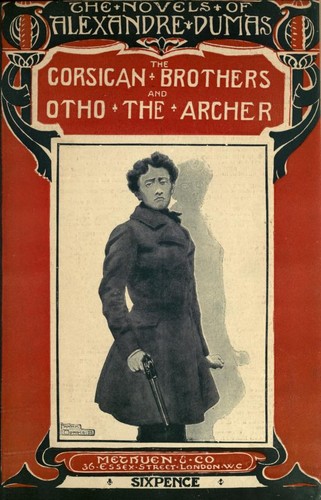
The Corsican Brothers
Alexandre Dumas · 1802–1870 · France
Originally Les Frères corses (French)
Why it matters
Twins separated at birth by surgery still share one nervous system: when one dies violently in a Paris duel, the other feels it instantly and rides for vengeance. Dumas compresses the vendetta novel into a short, feverish shock of a book.
At a glance
Very short and simply told, built for one sitting.
Deep dive
Twins separated at birth by the surgeon's knife still share a single nervous system across hundreds of miles, and when one of them ends up on the wrong side of a Paris duel, Dumas has the other feel it happen in real time.
Written for readers who have finished the book. No plot recap, and nothing here is safe to read first.
Themes & symbolism
Louis de Franchi has left Corsica for Parisian society, distancing himself from the island's blood-feud customs he considers barbaric, but the sympathetic bond he shares with his twin Lucien, who stayed behind to maintain the family vendetta, means he can never actually escape it: his body remains wired to his brother's regardless of what city he lives in or what values he claims to hold. Dumas is making a specific point about inheritance here, that culture and family obligation aren't simply choices a person can outrun by changing address, since Louis's own nerves keep him bound to Corsica whether he wants that or not.
The novella is built in two matched halves narrated from two different locations: the narrator first visits Lucien in Corsica and learns the vendetta history with the rival Orlandi and Colonna families, then later meets Louis in Paris and watches the same undercurrents of honor and obligation replay inside a completely different social setting, the codified world of the society duel rather than the mountain blood feud. Dumas draws the parallel explicitly rather than leaving it implicit: a Corsican vendetta and a Parisian duel are the same institution wearing two different costumes, both formalizing violence into something called honor.
Dumas grounds the twins' bond in genuine Corsican folk belief rather than inventing it from nothing: the narrator's Corsican hosts casually describe premonitory dreams and the island's mourning custom of the voceru, an improvised funeral lament sung over the dead, as ordinary facts of local life well before the plot supplies any supernatural payoff. That groundwork matters, since it lets the twins' shared nervous system read less as gothic novelty than as one more piece of a culture the narrator, and by extension the Parisian reader, has been told all along to take at its word.
One Story, Told Twice From Two Different Rooms
The structural repetition, the same emotional material staged once in feudal Corsica and once in fashionable Paris, is the novella's real experiment, more than the sensational nervous-sympathy premise that usually gets top billing. Dumas isn't simply padding a short book into two halves; he's arguing, by juxtaposition alone, that the vendetta and the duel are functionally identical, and letting the narrator's own naive surprise at each location stand in for the reader's slower recognition of the same pattern twice.
The last seal: what actually happens, and why it lands the way it does.
The ending, explained
Louis, goaded into a duel by the caddish Château-Renaud over a woman neither of them truly deserves, loses the fight, and Lucien in Corsica feels the fatal wound land in his own chest at the precise moment, hundreds of miles away, before any letter or telegram could possibly have reached him. He travels immediately to Paris, finds Château-Renaud, and kills him in a duel of his own, completing across the whole length of France the vendetta code his brother had spent years believing he'd left behind simply by moving to a more civilized address.
Where to go next
 Alexandre Dumas · 1844The Three MusketeersLvl 3Fast paced
 Alexandre Dumas · 1844The Count of Monte CristoLvl 4Fast paced
 Alexandre Dumas · 1845Twenty Years AfterLvl 3Fast paced
 Alexandre Dumas · 1845La Reine MargotLvl 4Fast paced
 Alexandre Dumas · 1850The Man in the Iron MaskLvl 3Fast paced
 Alexandre Dumas · 1850The Black TulipLvl 3Fast paced